There was a time when intranets actually felt like progress.
A central place. A single login. Documents, announcements, maybe a CEO message if someone remembered to update it. For a while, that was enough. It solved a real problem—information was scattered, and suddenly there was “one place” to go.
But work changed. And intranets didn’t.
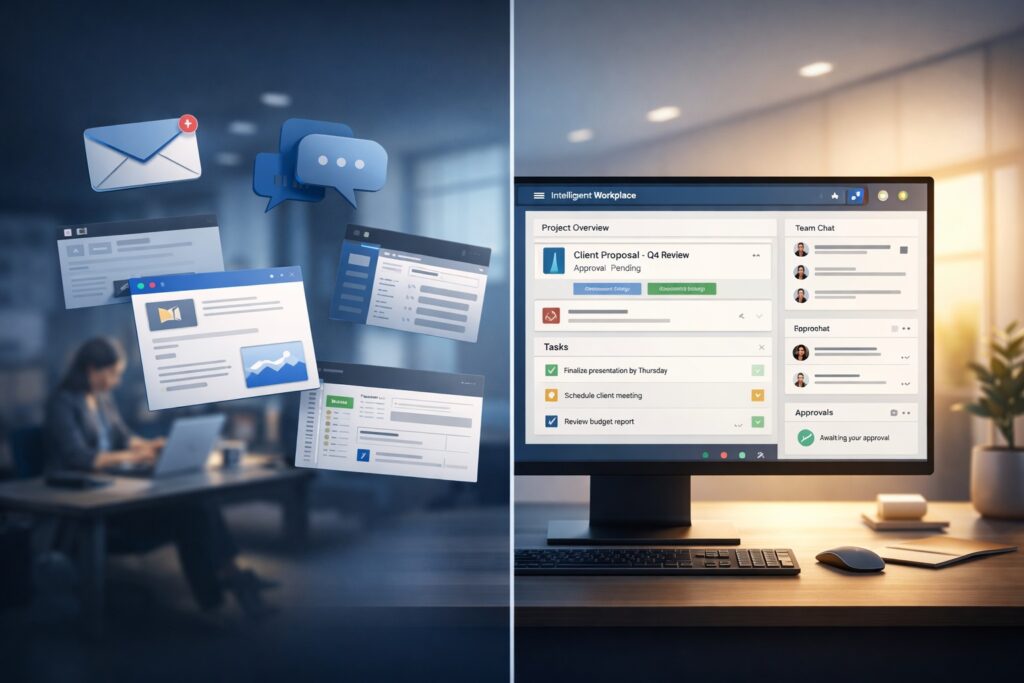
Today, if you ask someone where their work actually happens, they won’t say the intranet. They’ll say Teams, email, a project tool, maybe a shared drive, maybe ten tabs they forgot to close.
Work is happening everywhere—and nowhere at the same time. And the intranet? It’s still sitting there. Waiting. Ignored.
Work Was Never About Documents
Here’s where most organizations get it wrong. They think work is about content. Documents. Pages. Announcements.
It’s not. Work is messy. It’s conversations that turn into decisions. Decisions that turn into tasks. Tasks that depend on three other people who didn’t even know they were involved.
That entire flow? It doesn’t live in your intranet. It lives in fragments. A bit in email. A bit in chat. A bit in someone’s head. A bit in documents that are probably outdated. And that fragmentation is exactly why teams feel busy all the time but don’t feel effective.
The Real System of Work (That No One Designed)
If you zoom out, every organization already has a “system of work.”
It’s just accidental. Sales needs something from operations. Operations waits on finance. Finance doesn’t have context. Someone schedules a call. A decision gets made. Nobody records it properly. Two weeks later, the same discussion happens again.
Not because people are bad at their jobs. Because the system doesn’t support how work actually flows.
I’ve seen highly capable teams look inefficient simply because the environment they operate in forces them to be reactive. And then leadership tries to fix it with… another tool. Which makes it worse.
Why Intranets Keep Failing (Even After Redesigns)
Most companies don’t abandon intranets. They keep trying to improve them.
- Redesign the UI.
- Move to SharePoint.
- Add dashboards.
- Add more content.
But nothing really changes. Because the core assumption is still the same: “Give people a better place to find information.” But people don’t log in to find information. They log in because they need to get something done. That gap right there is why adoption never really sticks.
What an “Operating System for Work” Actually Means
This is where the shift happens.
An Operating System for Work is not just another platform. It’s a layer that understands how work moves inside an organization.
It knows:
- Who is doing what
- What depends on what
- What is stuck
- What needs attention
- What decisions are pending
And instead of forcing people to jump across tools, it connects everything into one experience. Not by replacing everything overnight—but by sitting above the chaos and bringing structure to it. When it works, it doesn’t feel like software. It feels like clarity.
From Tools to Flow
Right now, most organizations operate in a “tool mindset.”
- Need communication? Add a tool.
- Need project tracking? Add another tool.
- Need HR? Another system.
Before you know it, you have 8–10 systems doing overlapping things. An operating system approach flips that. Instead of thinking in tools, it thinks in flow.
- How does work start?
- Where does it move?
- Where does it get blocked?
- How do people collaborate in context—not across tabs?
This is also where the conversation connects to something bigger. We’re moving from tools to intelligence. And this becomes critical in 👉 “From Tools to Intelligence: The Shift Towards AI-Driven Work Platforms”
The Intelligence Layer Is the Game Changer
Earlier systems were passive. They waited for you to search, click, or update something.
Now imagine a system that:
- Surfaces what actually matters right now
- Suggests next steps
- Helps you write, summarize, decide
- Connects context automatically
That’s not a feature. That’s a different category of system. And this is exactly why traditional setups are starting to feel outdated—not because they’re broken, but because they were never designed for this level of complexity.
Why This Matters More Than Ever
The pressure on organizations has changed. Teams are distributed. Work is faster.
Expectations are higher. But the internal systems haven’t evolved at the same pace.
So what happens? People compensate. They follow up manually. They maintain parallel trackers.
They repeat conversations. All invisible inefficiencies. Multiply that across an organization, and the cost becomes massive. Not in software spend. In lost momentum.
This Isn’t a Technology Problem
This is important. Most leaders assume this is a tech problem. It’s not. It’s a design problem.
The way work is structured, surfaced, and supported inside the organization—that’s the real issue. Technology is just the enabler. Which is why simply adding more tools never solves it.
Where This Is Heading
We’re at an interesting point right now. Organizations are starting to realize that:
- Tools alone don’t create efficiency
- Information alone doesn’t create clarity
- Communication alone doesn’t create alignment
What they actually need is a system that connects all three.
- Seamlessly.
- Intelligently.
- In context.
That’s what an Operating System for Work does.
Final Thought
If your internal platform still feels like a place you “go to read things,” you’re already behind.
The real question is: Does your system help people understand what needs to happen next?
Because that’s what work really is. Everything else is just noise.